The contact centre is no longer just a cost line on a spreadsheet. With the right AI strategy, it becomes a powerful growth engine that delights customers, empowers agents, and unlocks data-driven decisions. Instead of long queues, repetitive questions, and burned-out teams, AI in contact centre solutions deliver faster, smarter, and more personalised support at scale. For deeper AI call center insights, organisations are discovering how intelligent automation is reshaping the way customer service drives business growth.
Building a modern contact centre requires more than just implementing technology; it’s about creating a connected ecosystem where data flows seamlessly. Companies exploring cutting-edge computing innovations have noticed how integrating advanced systems can enhance customer experience and operational efficiency. Similarly, understanding the impact of high-performance supercomputers for analytics can help contact centres process large datasets, predict trends, and personalise interactions in real time.
Marketing strategies also play a crucial role in maximising the value of AI-enabled customer support. Leveraging insights from marketing strategies for customer engagement allows agents to tailor responses and anticipate customer needs. For teams looking to accelerate digital campaigns while aligning with service goals, resources like practical marketing tips for fast-growing businesses provide actionable guidance that complements intelligent contact centre operations.
Finally, financial planning and resource management are key to sustaining AI-driven initiatives. Accessing top financial planning resources online ensures that organisations can scale AI investments responsibly while keeping service quality high. By combining technology, marketing, and financial insight, modern contact centres can not only improve efficiency but also create memorable experiences that drive loyalty and growth.
Top 10 AI in Contact Centre Solutions to Transform Customer Service
AI in contact centre technology is reshaping how businesses interact with customers, streamline operations, and drive growth. From intelligent automation to predictive analytics, these platforms help organisations deliver faster, smarter, and more personalised support. Here’s a list of the top solutions in the market today:
1. Bright Pattern
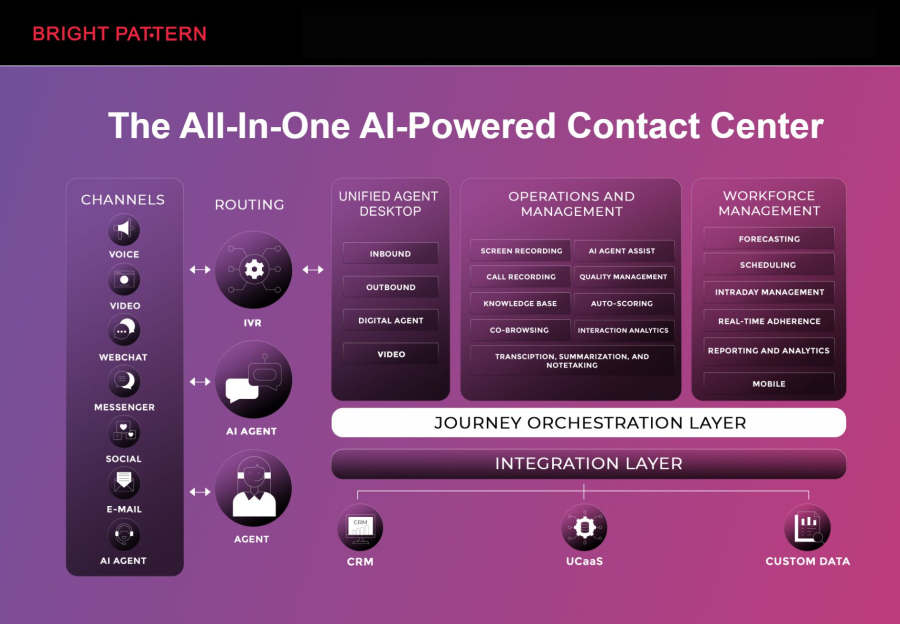
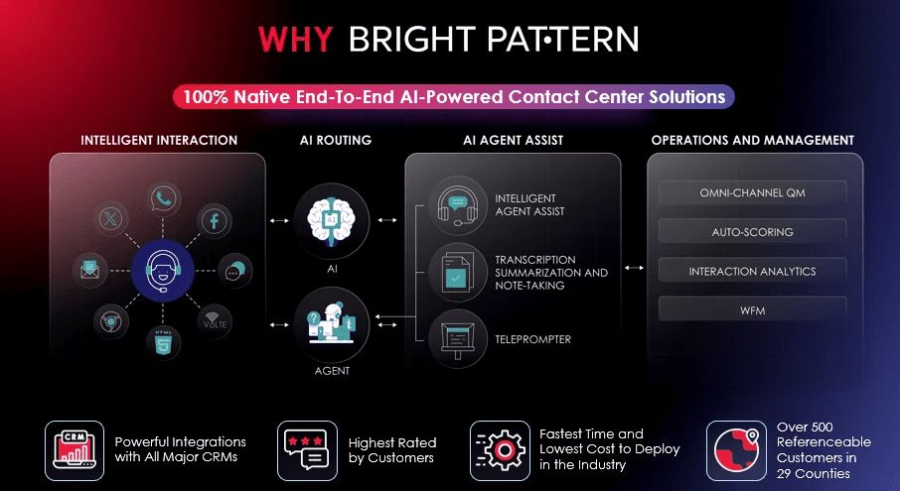
Bright Pattern is a leading platform for AI in contact centre solutions, offering a cloud-native, omnichannel approach to customer engagement. Its advanced AI capabilities enable businesses to automate routine tasks, enhance agent productivity, and deliver seamless customer experiences.
Key features include:
- Omnichannel routing across voice, chat, email, and social media
- AI-powered chatbots and virtual agents for faster response
- Predictive analytics for data-driven decision-making
- Easy integration with CRM systems and business tools
- Scalable cloud infrastructure to support global operations
Bright Pattern’s platform is designed to empower agents while reducing customer wait times, making it a top choice for organisations looking to future-proof their contact centres.
2. Genesys Cloud
Genesys Cloud offers AI-driven contact centre software with powerful automation, predictive routing, and real-time analytics to improve customer satisfaction.
3. Five9
Five9 provides a cloud contact centre solution that leverages AI for intelligent call routing, chatbots, and performance optimization.
4. NICE inContact
NICE inContact combines AI and analytics to deliver personalised customer experiences and optimise agent workflows.
5. RingCentral Contact Center
RingCentral integrates AI capabilities to support omnichannel engagement, intelligent automation, and workforce management.
6. Talkdesk
Talkdesk uses AI in contact centre operations to streamline processes, enhance agent efficiency, and provide actionable insights.
7. Cisco Contact Center
Cisco’s platform applies AI-driven analytics and virtual assistants to improve customer experience and operational efficiency.
8. Avaya OneCloud
Avaya OneCloud leverages AI for routing, automation, and speech analytics to deliver seamless and personalised interactions.
9. 8x8 Contact Center
8x8 integrates AI into its contact centre platform to enhance engagement, improve first-contact resolution, and support multiple channels.
10. Zendesk Suite
Zendesk Suite includes AI-powered chatbots, automated workflows, and advanced analytics to help teams deliver consistent and efficient support.
What Do We Mean by AI in the Contact Centre?
AI in the contact centrerefers to technologies that use machine learning, natural language processing, and automation to understand customer intent, support agents, and streamline operations. It works across channels like voice, chat, email, messaging apps, and social media.
Common AI components include:
- Conversational AIfor chatbots and voice bots that handle customer queries in natural language.
- Agent assisttools that suggest answers, next best actions, and knowledge articles in real time.
- Intelligent routingthat matches customers with the best available agent or automated flow.
- Speech and text analyticsthat mine every interaction for insights, trends, and coaching moments.
- Predictive modelsthat forecast demand, churn risk, satisfaction, and staffing needs.
Why AI Matters Now: The Shift in Customer Expectations
Customer expectations have changed dramatically. People wantinstant, accurate, and personalisedhelp on the channel of their choice, without repeating information or waiting in long queues. At the same time, contact centres face pressure to control costs and improve agent experience.
AI helps close this gap by delivering:
- Always-on supportthat handles a large part of volume 24 / 7, without compromising quality.
- Consistent answersbased on a single, centralised knowledge source.
- Proactive outreachbefore issues escalate, reducing complaints and churn.
- Empowered agentswho can focus on higher value, more engaging conversations.
Key Benefits of AI in the Contact Centre
1. Faster Resolution and Lower Handle Times
AI dramatically reduces time to resolution by removing friction at every step of the interaction.
- Virtual agentsinstantly answer common questions such as order status, password resets, billing queries, and appointment changes.
- Smart triagecollects key information upfront, so when a customer reaches an agent, the context and history are already on-screen.
- Real-time suggestionsprovide agents with recommended responses, next steps, and relevant articles, eliminating time spent searching.
The result is shorter average handle time and quicker answers, without rushing or sacrificing quality.
2. Reduced Costs Without Sacrificing Experience
AI allows contact centres to handle more interactions with the same or fewer resources, while actually improving the customer experience.
- Automation of high volume, low complexity queriesfrees agents to focus on complex or high value interactions.
- Smarter self servicereduces call and chat volumes by guiding customers to effective solutions before they queue for an agent.
- Accurate forecasting and staffingpowered by AI helps reduce overstaffing and understaffing, optimising workforce costs.
Instead of endless cost cutting, AI enables a more sustainable model: invest once in intelligence, then scale service quality at a far lower incremental cost.
3. Hyper Personalised Customer Experiences
AI brings context and personalisation into every interaction, turning generic service into tailored experiences.
- Unified customer profileshelp both bots and agents see previous interactions, preferences, and purchases.
- Intent detectiongoes beyond keywords to understand what the customer is really trying to achieve.
- Next best action recommendationssuggest relevant offers, solutions, or retention tactics tailored to that customer.
Customers experience a more natural, human like interaction where they feel recognised and valued rather than treated like a case number.
4. Happier, More Effective Agents
AI does not replace agents; it elevates them. By removing repetitive tasks and cognitive overload, AI allows agents to focus on what humans do best: empathy, judgment, and relationship building.
- Agent assistsurfaces suggested answers, compliance prompts, and knowledge in real time.
- Automated after call workdrafts summaries and disposition codes, reducing admin time.
- Coaching insightsfrom analytics help managers provide targeted feedback and recognise great performance.
This leads to higher job satisfaction, less burnout, and lower turnover, which further strengthens customer relationships.
5. Rich Insights From Every Conversation
Traditional quality monitoring only samples a tiny portion of calls and chats. With AI, you can unlock insights fromeveryinteraction.
- Speech and text analyticsautomatically classify topics, sentiment, and outcomes.
- Trend analysisreveals emerging issues, product feedback, and process bottlenecks.
- Root cause insightsconnect contact drivers to underlying policies, product changes, or operational gaps.
These insights go far beyond the contact centre, helping marketing, product, operations, and leadership make better decisions based on the voice of the customer.
Core AI Use Cases in Modern Contact Centres
AI is not a single tool but a collection of capabilities that can be combined to transform the entire customer journey.
1. AI Powered Virtual Agents (Chatbots and Voice Bots)
Virtual agents are often the first touchpoint. When designed well, they can resolve a large proportion of queries end to end.
- Handle FAQs such as order tracking, account information, and simple troubleshooting.
- Gather information before handoff, such as customer identity, issue description, and preferences.
- Provide transactional services like booking, cancellations, and changes, based on business rules.
The goal is not to hide agents behind bots, but to make it easy for customers to get fast, reliable help and smoothly escalate to a human when needed.
2. Real Time Agent Assist
While a conversation is underway, AI listens (or reads) in the background and supports the agent.
- Suggests relevant knowledge articles and policies based on what the customer is asking.
- Prompts agents on compliance statements, such as disclosures or verification steps.
- Displays dynamic scripts and next best actions to guide complex processes.
This reduces training time for new hires and helps experienced agents keep up with policy, product, and process changes effortlessly.
3. Intelligent Contact Routing
Routing decisions can make or break customer experience. AI enhances routing by looking beyond simple skills and queues.
- Routes based on predicted customer intent and value, not just IVR selections.
- Pairs customers with the agents most likely to resolve their issue effectively.
- Balances workload to maintain service levels and reduce wait times.
When customers reach the right person or resource the first time, first contact resolution increases and frustration drops.
4. AI Driven Quality Monitoring and Compliance
Instead of manual call sampling, AI can automatically evaluate every interaction against quality and compliance criteria.
- Detects whether mandatory statements were read, or processes were followed.
- Flags potential escalations or negative sentiment for quick follow up.
- Identifies top performing behaviours that can be replicated across the team.
This not only protects the organisation but also gives managers more objective and timely insights to support their teams.
5. Workforce Management and Forecasting
Accurate forecasting is a constant challenge for contact centres. AI enhances workforce management by analysing historical patterns, seasonality, and external signals.
- Improves forecast accuracy for different channels and contact types.
- Optimises schedules and shifts to align staffing with predicted demand.
- Supports scenario planning for campaigns, launches, or disruptions.
The outcome is a better balance between service levels, agent wellbeing, and cost control.
6. Knowledge Management and Search
AI transforms static knowledge bases into dynamic, intelligent resources.
- Understands natural language queries, not just keywords, to find relevant answers.
- Continuously learns from resolved cases to improve article relevance.
- Surfaces the right content to the right person at the right time, whether agent or customer.
Everyone spends less time searching and more time resolving.
Overview of AI Capabilities and Business Value
|
AI Capability |
Primary Benefit |
Typical Impact Area |
|
Virtual agents |
Automate common queries and provide 24 / 7 self service |
Cost reduction, customer convenience |
|
Agent assist |
Support agents with real time guidance and knowledge |
Handle time, first contact resolution, agent experience |
|
Intelligent routing |
Match customers with the best resource or flow |
Customer satisfaction, efficiency |
|
Speech and text analytics |
Turn every interaction into insight |
Quality, coaching, product and process improvement |
|
Workforce forecasting |
Align staffing with predicted demand |
Service levels, cost control, agent wellbeing |
|
Knowledge intelligence |
Deliver fast, accurate answers |
Resolution speed, consistency, self service success |
Realistic Transformation Journey: From Pilot to Scaled AI
Implementing AI in the contact centre does not have to be a big bang project. Many organisations see success by starting small, learning quickly, and scaling what works.
Step 1: Clarify Objectives and Metrics
Before selecting any tool, define what success looks like. Common objectives include:
- Reducing average handle time while maintaining or improving customer satisfaction.
- Increasing self service resolution for specific contact reasons.
- Improving first contact resolution and reducing repeat contacts.
- Boosting agent satisfaction and reducing attrition.
Link these objectives to clear, trackable metrics so that impact can be measured and communicated.
Step 2: Prioritise Use Cases With High Impact and Low Risk
Early wins build momentum. Look for opportunities where AI can add immediate value without complex integrations or sensitive topics.
- Automating a small group of high volume, simple queries with a virtual agent.
- Rolling out real time knowledge suggestions for a subset of teams.
- Using analytics on recorded calls to identify quick coaching improvements.
These pilots demonstrate value and help refine your design, processes, and governance.
Step 3: Prepare Data and Knowledge Foundations
AI performs best when it has clean, organised data and well structured knowledge to draw from.
- Consolidate and review existing knowledge articles, FAQs, and scripts.
- Standardise categories for contact reasons, outcomes, and dispositions.
- Ensure customer profiles and interaction histories are as complete and accessible as possible.
Strong foundations make AI more accurate, reliable, and easier to maintain.
Step 4: Involve Agents Early and Often
Agents are critical partners in AI adoption. They understand real customer needs, edge cases, and what truly helps in live conversations.
- Invite front line agents to test and give feedback on AI tools.
- Highlight how AI removes pain points rather than replaces jobs.
- Incorporate their suggestions into design, scripting, and workflows.
When agents feel heard and see direct benefits in their daily work, adoption accelerates.
Step 5: Measure, Optimise, and Scale
AI is not a set and forget project. It thrives on continuous learning and optimisation.
- Monitor metrics frequently and compare to your pre AI baseline.
- Identify where customers drop out, get confused, or escalate unnecessarily.
- Refine language, flows, and knowledge based on real world performance.
As results stabilise and improve, extend AI capabilities to more channels, regions, and use cases.
How to Measure the Success of AI in Your Contact Centre
To demonstrate value, combine traditional contact centre metrics with AI specific measures.
Customer Experience Metrics
- Customer satisfactionandnet promoter scoreafter AI enabled interactions.
- First contact resolutionacross both self service and assisted channels.
- Average speed of answerand queue times before and after AI deployment.
Operational Efficiency Metrics
- Containment ratefor virtual agents: percentage of interactions resolved without agent handoff.
- Average handle timeandafter call work timefor assisted contacts.
- Cost per contactacross channels and use cases.
Agent Experience Metrics
- Agent satisfactionand engagement survey results.
- Turnover and absenteeismtrends over time.
- Speed to competencyfor new hires using AI assisted tools.
Business Outcome Metrics
- Revenue influencedby better cross sell, upsell, and retention in service interactions.
- Churn reductionin segments exposed to AI enhanced support.
- Issue preventiondue to early detection through analytics and proactive outreach.
Future Trends: Where AI in Contact Centres Is Heading
AI in contact centres continues to evolve rapidly. Several trends are shaping the next generation of customer experience.
More Human Like Conversations
Advances in natural language understanding, voice synthesis, and dialogue management are making AI interactions feel more fluid, empathetic, and context aware. Customers increasingly expect bots to understand nuance, not just basic commands.
Proactive and Predictive Service
Instead of waiting for customers to call, AI will increasingly anticipate needs based on behaviour, history, and external signals. Contact centres will reach out to solve problems before the customer notices them, creating a powerful loyalty advantage.
Tighter Integration Across the Customer Journey
AI will more deeply connect marketing, sales, service, and back office processes. Context from previous touchpoints will automatically flow into support interactions, and insights from service will feed back into product and experience design.
Agent Roles Evolving to Experience Specialists
As AI takes on more routine tasks, human agents will focus on high value scenarios: complex problem solving, relationship management, and emotionally charged interactions. The role becomes more strategic and rewarding, supported by AI as a digital co pilot.
Bringing It All Together
AI in the contact centre is not just about technology. It is about reimagining how you serve customers, support your teams, and grow your business.
When AI is thoughtfully implemented, customers get faster, more personalised support, agents get the digital tools they deserve, and leaders get the insights to steer the entire customer experience with confidence.
By starting with clear goals, focusing on practical use cases, and building on solid data and knowledge foundations, any contact centre can turn AI from a buzzword into a measurable competitive advantage.
The organisations that act now will set a new standard for customer experience, turning their contact centres into engines of loyalty, advocacy, and sustainable growth.
